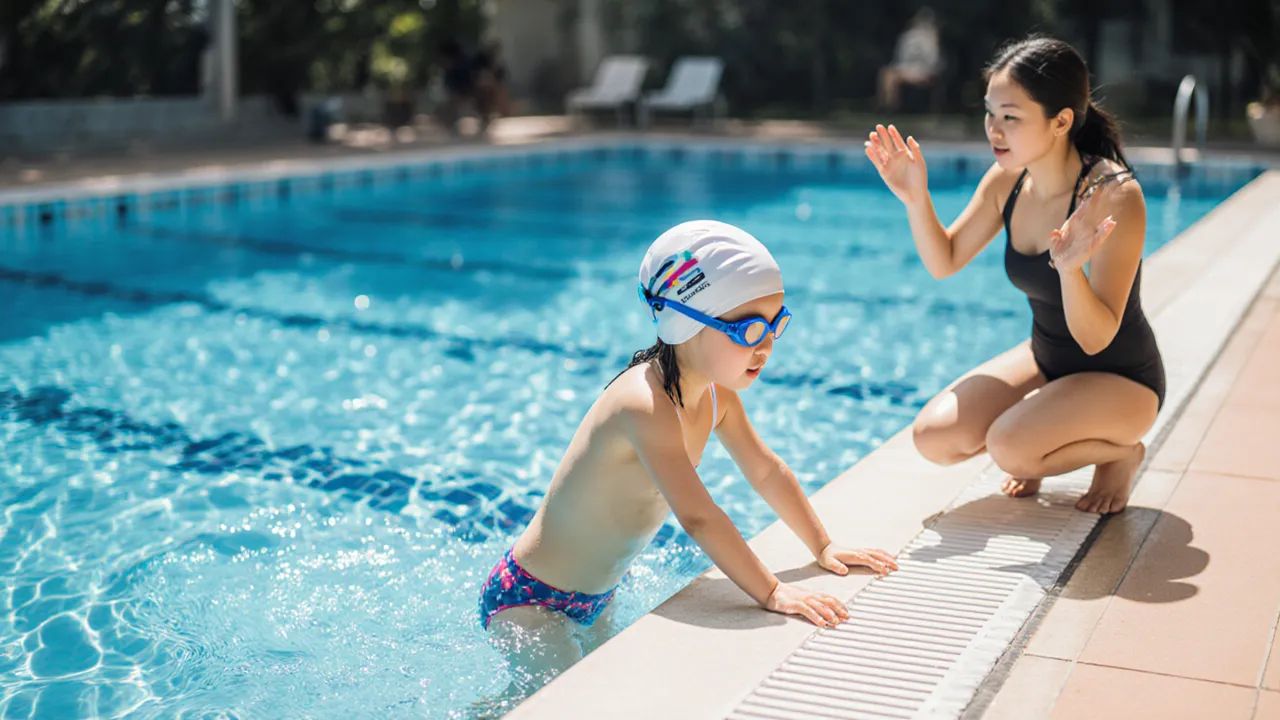
Your child just passed Stage 2. Three months later, another parent at the pool mentions their child is already in Stage 3, and the question lands: should mine be moving up too? It is one of the most common things Singapore parents ask us, and the honest answer is that the calendar is a poor guide. Some children are ready after one 12-week cycle. Others need two, and are better for it.
This guide explains what each SwimSafer 2.0 stage actually asks of a child, the practical signs that your child is ready to progress, and the signs that rushing would backfire. By the end you should be able to watch one lesson and make a fair call yourself.
How SwimSafer 2.0 stages work (and why “ready” isn’t about age)
SwimSafer 2.0 is Singapore’s national water-safety programme, run through ActiveSG. It has six stages, and each is designed around roughly 12 hours of lesson time. Stages 1 to 3 build water confidence and the basics: entering and exiting safely, moving forwards and backwards, sculling, and underwater skills. Stages 4, 5 and 6 are the Bronze, Silver and Gold levels, where stroke technique, survival skills and distance take over.
The distance targets give you a useful yardstick. Stage 2 expects a 25 m continuous swim, Stage 3 asks for 50 m, Stage 4 for 100 m across a variety of strokes, Stage 5 for 200 m within a time frame, and Stage 6 for 400 m with each stroke inside a time frame. Each stage is passed through a practical assessment and an online theory quiz.
Notice what is not on that list: age. A confident, coordinated five-year-old can be further along than an anxious nine-year-old, and neither is “behind”. At Ace Dolphin we combine SwimSafer 2.0 with Japan’s Tatsuki methodology in 12-week grading cycles, so each child’s progress is tracked skill by skill rather than by birthday. That is the lens we recommend parents use too.
Five signs your child is ready to move up
No single sign settles it. Look for several of these appearing together, and appearing consistently, not just on a good day.
1. They can do the current stage’s skills without being cued
A child who only floats when the coach says “float now” has learned to follow instructions, not to float. Readiness looks like the skill happening automatically: a glide off the wall with the body already streamlined, breathing that happens on rhythm without prompting, a recovery to standing that needs no help.
2. Their distance is comfortable, not a struggle
If the target for the next stage is 50 m and your child can only just scrape through 25 m, gasping at the wall, they are not ready. Ready looks like finishing the current distance with energy left over and being able to do it twice in a row. Stamina is often the quiet gatekeeper at Stages 3 and 4.
3. Their technique holds up when they are tired
Almost every child swims a lovely length when fresh. Check the third or fourth length. Do the kicks stay from the hips, do the arms keep reaching, does the head stay low? Technique that survives fatigue is technique that is truly learned. If you want to see how a good technique foundation is built, our post on SwimSafer 2.0 explained for parents goes deeper.
4. They are relaxed in deep water
From Stage 3 onwards, deep-water confidence matters more. Watch how your child behaves where their feet cannot touch: calm and curious, or tense and grabbing the lane rope? A child who is still anxious in deep water will struggle with the survival and rescue skills that come next, no matter how pretty their freestyle looks.
5. They want to move on
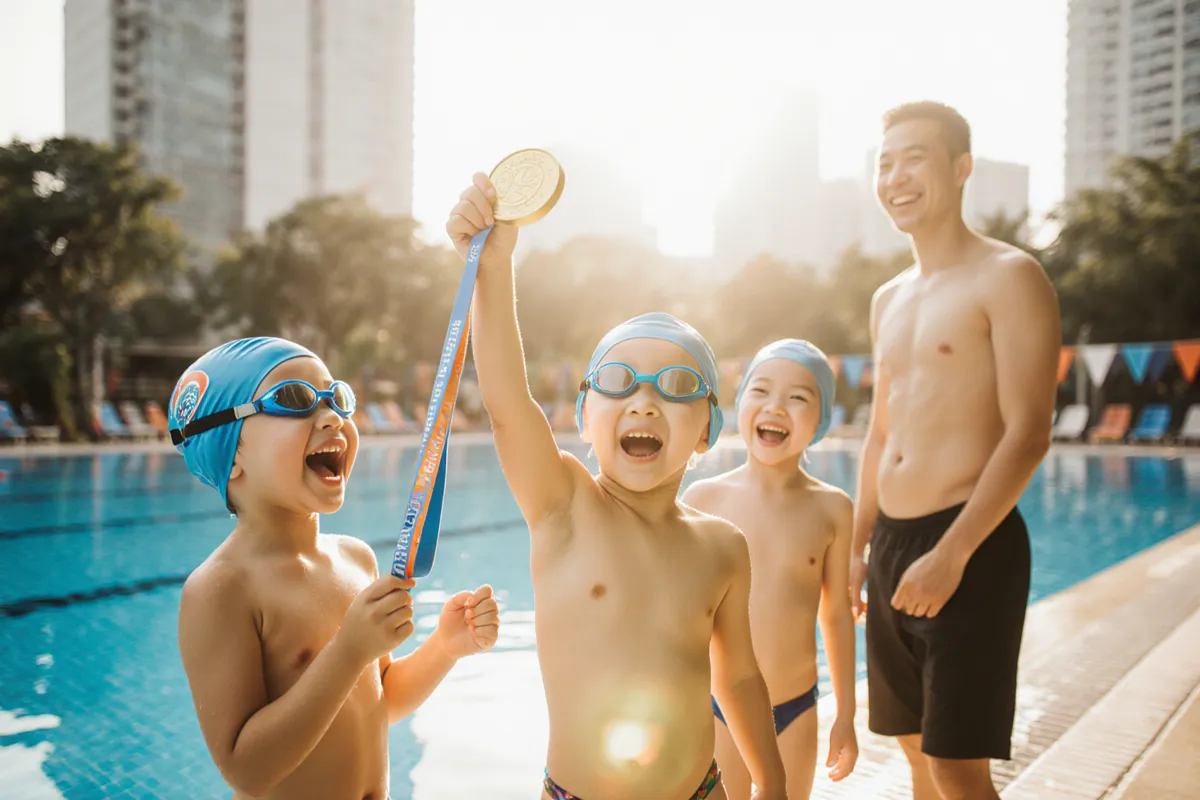
This one is underrated. A child who asks “when can I do the next one?” or who keeps trying the harder skill at the end of the lesson is telling you something. Motivation matters, which is why Ace Dolphin’s swim bands and custom medals mark each milestone: children can see progress, and parents can see what the next target is.
What the practical assessment actually checks
Passing a stage means passing a practical assessment and an online theory quiz. Private assessments are booked through the CAMS platform run by Singapore Aquatics, with registration and payment due about three weeks before the assessment. Our guide to booking a SwimSafer test walks through the steps.
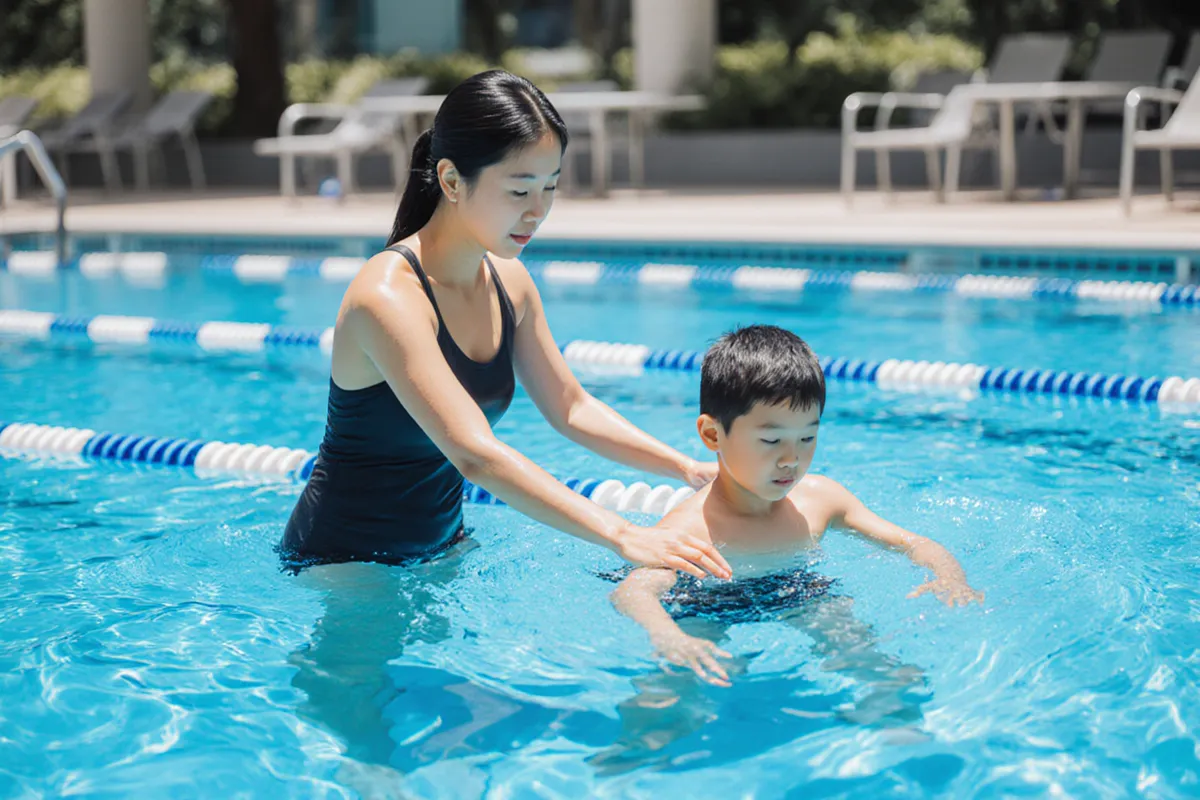
The practical is not a stroke beauty contest. Assessors look at whether the child performs each skill safely and competently, including entries and exits, sculling, underwater skills, movement and strokes, survival and rescue skills at the higher stages. A child can swim a fast 50 m and still not pass Stage 3 if they cannot put on and swim with a personal flotation device, for example.
One point worth knowing: ActiveSG has reminded instructors that they should validate a child for assessment only when the child is genuinely ready for the stage. This is good news for parents. A coach who says “not yet” is following the rules, and protecting your child from a disappointing result, not holding them back.
Signs your child needs another cycle first
Staying in a stage for another 12 weeks is not failure. Some of the strongest swimmers we have taught spent extra time at Stage 2 or 3, because those stages build the foundation that makes Stages 4 to 6 feel easy. Look out for these flags:
- Skills work only with support. If your child needs a coach’s hand nearby, a kickboard or a lane rope to complete the skill, they are not independent yet.
- Good days and bad days swing wildly. Consistency is the real test. One great lesson is not a pass.
- Fear shows up at the edge of the pool. Hesitation, tears or refusing to put the face in point to confidence gaps. Our guide to overcoming fear of water and the post on what to do when your child cries at lessons cover this.
- Technique has bad habits baked in. Scissor kicks, lifted heads and one-sided breathing get harder to fix the faster a child moves up. See why technique needs fixing early.
Pushing a child up too early tends to show up a stage later, as a plateau, a wobble in confidence or a failed assessment that dents their enthusiasm. Slow and solid beats fast and shaky.
Stage-by-stage: what “ready” looks like
Use this as a rough checklist when you watch a lesson from the pool deck.
- Ready for Stage 2: comfortable with the face in the water, floats and glides without support, moves forwards and backwards independently.
- Ready for Stage 3: swims 25 m continuously, scull and feet-first surface dive are reliable, calm when the water is deeper than they are tall.
- Ready for Stage 4 (Bronze): swims 50 m without stopping, breathes in rhythm, tolerates a few strokes without losing form.
- Ready for Stage 5 (Silver): swims 100 m across several strokes with consistent technique and is learning to pace themselves.
- Ready for Stage 6 (Gold): swims 200 m or more with efficient strokes and understands the survival skills, from improvised flotation to the Heat Escape Lessening Posture.
These are guides, not rules. The coach in the water sees details you cannot from the side, so treat this as the start of a conversation rather than a verdict.
How to ask your coach the right question
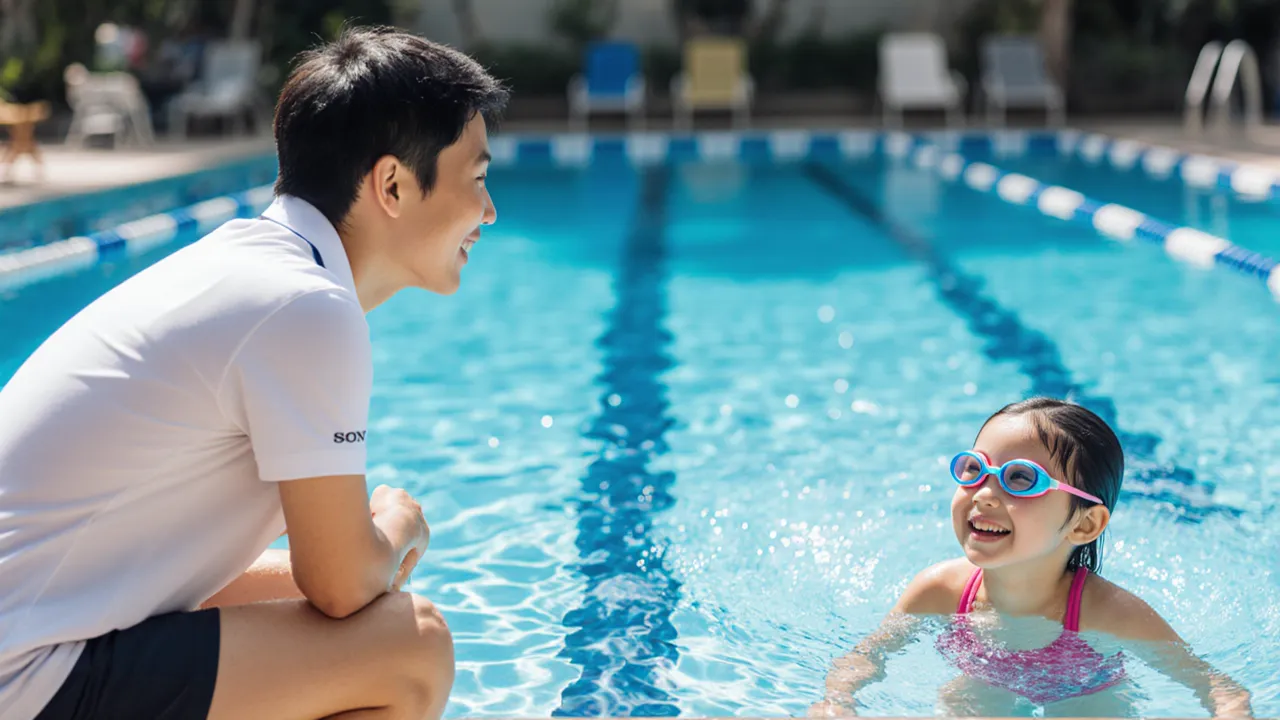
“Is my child ready to move up?” invites a yes or no. Better questions get you more: “Which skills are still inconsistent?”, “What would you want to see before recommending an assessment?”, and “How many more weeks of practice does that look like?” A good coach will answer with specifics, and many will show you the skill on the day.
It also helps to know your options. Group classes are great for steady progression with peers, while private lessons can target the one skill holding a child back, whether that is breathing, deep-water confidence or a stubborn kick. If you are weighing the two, our private vs group guide lays out the trade-offs honestly. And if your child has missed lessons, our piece on restarting after a break explains how much to expect to relearn.
Why getting this right matters in Singapore
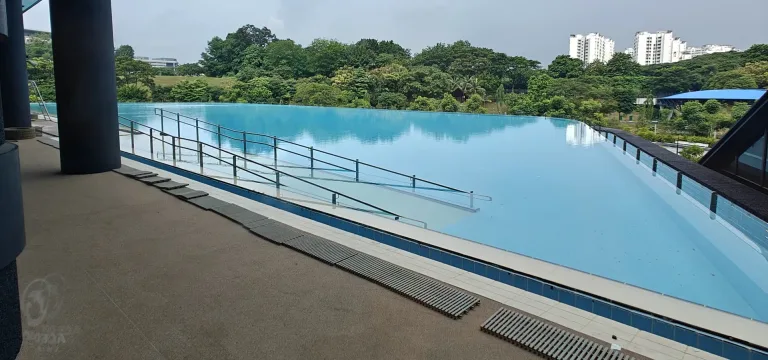
Water safety is not optional for children growing up on a small island with condo pools, ActiveSG complexes and beaches within easy reach. SwimSafer is the national benchmark, and many schools use it as part of their own programmes, so the stage your child reaches has real meaning beyond a certificate. Taking a few extra weeks to be properly ready is a small price for skills that stay with them for life.
Conclusion
A child is ready for the next SwimSafer stage when the current skills are independent, consistent and calm, when the distance feels comfortable and the technique holds up under fatigue. Age, friends’ progress and the date on the calendar are all poor guides. If you remember one thing, make it this: a pass that is earned properly makes every later stage easier.
At Ace Dolphin, our NROC-certified coaches track each child’s progress through 12-week cycles and give you a straight answer about readiness, with no pressure either way. To talk about where your child sits in the SwimSafer framework, browse our kids swimming lessons, meet our coaches, or contact us at admin@acedolphin.com or +65 9105 5244.