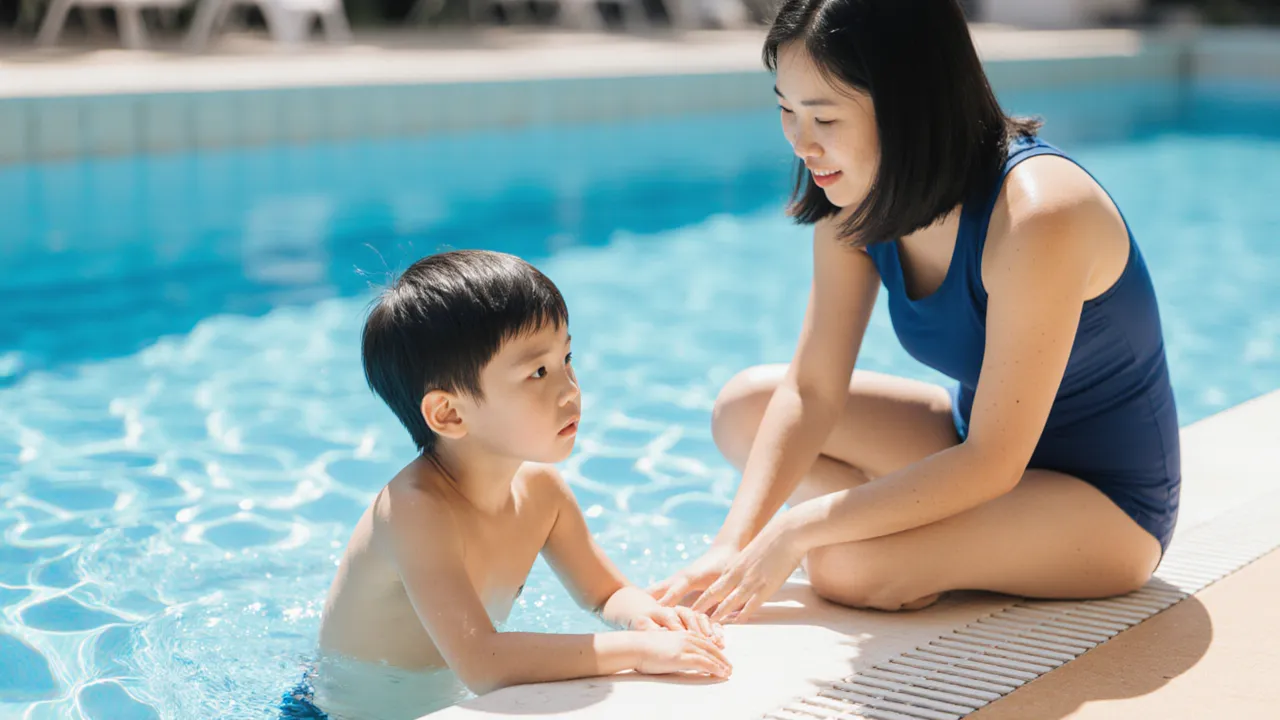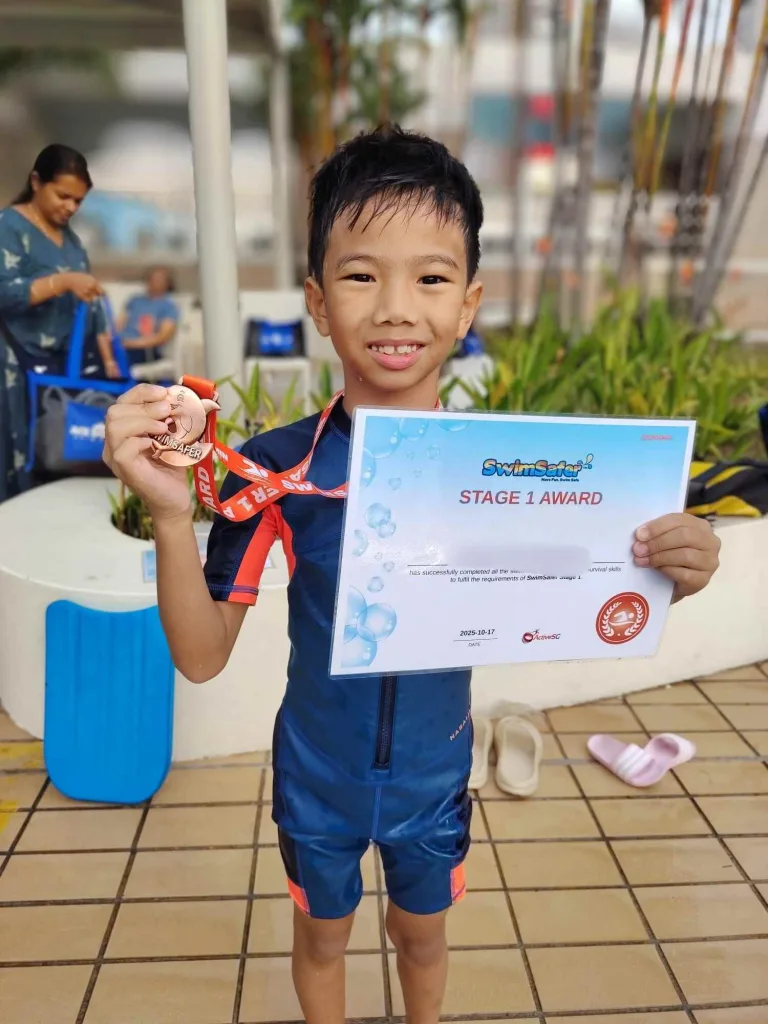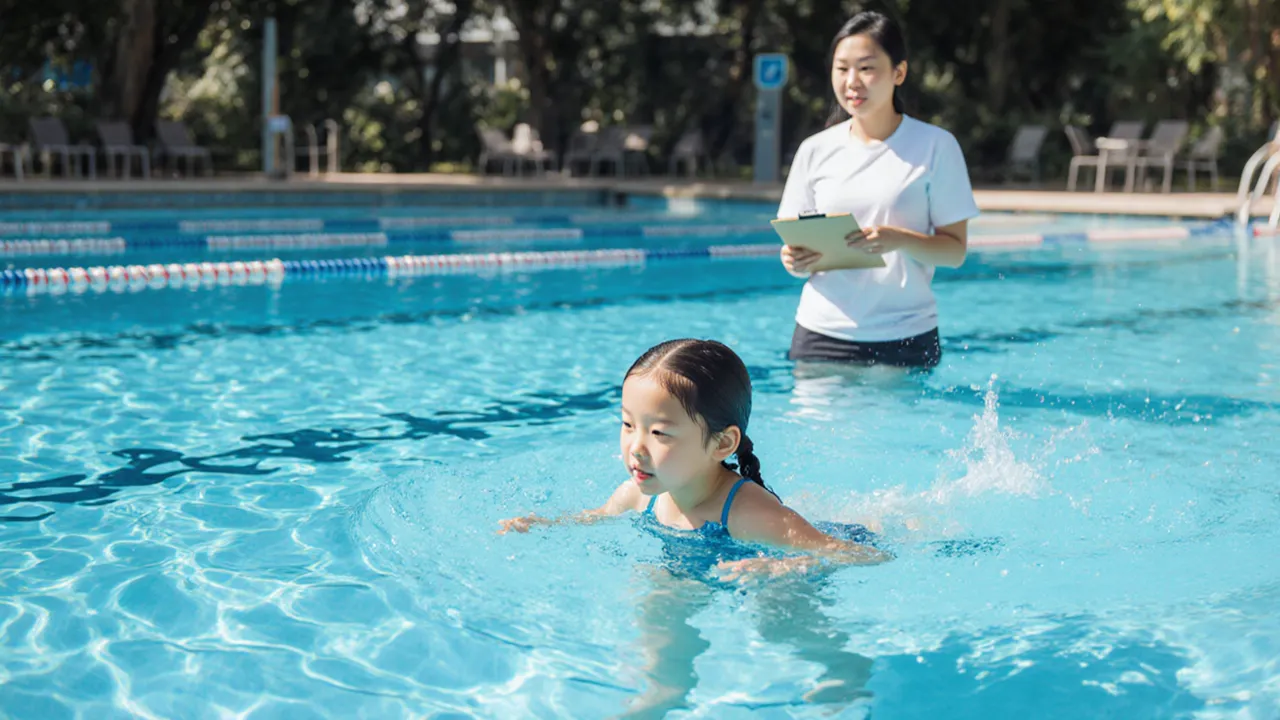
You’re sitting on the pool deck at Our Tampines Hub, watching your child’s lesson through the glass. She’s been in Stage 2 for a while now, and from where you sit, she looks fine, kicking happily, going under without fuss. So why hasn’t she moved up? Or the opposite worry: your son just got bumped to Stage 4 and you’re quietly wondering if he’s actually ready. Most Singapore parents can’t tell from the deck what coaches are looking for, because readiness isn’t about looking busy in the water. It’s about specific, observable skills. This guide breaks down exactly what those skills are at each SwimSafer stage, the signs you can spot yourself, and what to do if your child seems stuck.
How SwimSafer 2.0 Progression Actually Works
SwimSafer 2.0 is Singapore’s national water safety framework, and it’s built as six progressive stages: Stages 1 to 3, then Bronze, Silver, and Gold. Each stage ends with a practical assessment against a fixed checklist of criteria, plus an online water-safety theory quiz. The journey runs from a first assisted float all the way to Gold, roughly 400 metres of continuous swimming, multiple strokes, and survival skills performed in clothing.
Here’s the part that surprises many parents: assessment is criteria-based, not effort-based. A child either demonstrates every required skill on test day or is marked “Not Yet Competent” for that stage. There’s no partial credit and no rounding up for a child who “almost” managed the 25-metre swim. This is a feature, not a flaw. The certificate is a safety credential, and Singapore’s framework is deliberately strict about it.
It also means progression isn’t tied to age or how many terms your child has attended. A confident six-year-old can overtake a hesitant nine-year-old. At Ace Dolphin, lessons run in 12-week progressive grading cycles, so there’s a natural rhythm: skills are built and refined across the cycle, and children are graded when the criteria are consistently met, not just managed once on a lucky day. That word, consistently, is the single most useful lens for judging readiness, and it applies at every stage below.
Early Stages (1 and 2): Watch for Water Confidence, Not Just Skills
The first two stages are less about swimming and more about being genuinely comfortable in water. Stage 1 covers pool entries and exits, submerging, breath control, floating, and moving through the water with support. Stage 2 pushes towards unassisted entries, sculling, and a continuous 25-metre swim.
Signs your child is ready to move up from Stage 1 or 2:
- They put their face in the water without being asked. Voluntary submersion, during play, not just on instruction, is the clearest sign the foundational fear is gone.
- They can float on their front and back calmly, and recover to standing on their own. Recovery is the skill assessors care about most; floating is only useful if a child can get out of it safely.
- They blow bubbles rhythmically rather than holding their breath. Breath control is the gateway skill to every stroke that follows. A child who exhales underwater in a relaxed rhythm is ready for more; a child who surfaces gasping is not, yet.
- They’re relaxed enough to be taught. If your child spends the first ten minutes of every lesson re-warming to the water, they’ll pass eventually, but they’re not ready to progress this cycle.
For anxious children, this cluster is where progression most often stalls, and where pushing hardest backfires. Ace Dolphin’s coaches specialise in exactly this profile of child, using a calm, no-forced-progression approach that has converted thousands of water-fearful kids into independent swimmers. If your child is stuck here, the answer is almost never “more pressure”; it’s a coach who knows how to rebuild trust in the water.
Middle Stages (3 and Bronze): Watch for Technique and Stamina
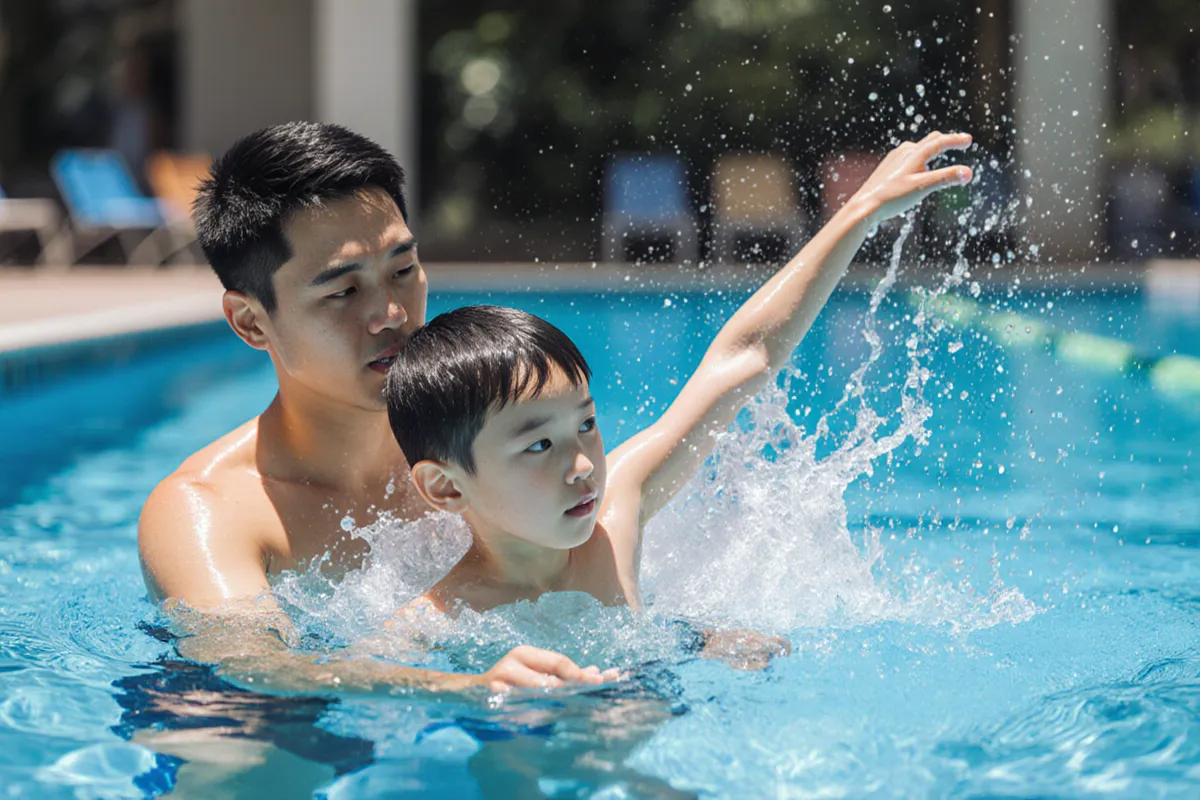
From Stage 3 onwards, SwimSafer shifts from confidence to competence. Stage 3 introduces proper stroke work and a 50-metre continuous swim; Bronze demands coordinated technique across strokes, a 100-metre swim, and more advanced personal survival skills like treading water.
Signs your child is ready to move up:
- Their strokes look smooth, not frantic. A ready child covers the distance with long, unhurried movements. A child who finishes 50 metres through sheer determination, legs sinking, head craning, arms windmilling, has the stamina but not yet the technique, and technique is what gets assessed.
- They breathe rhythmically to the side during freestyle. Lifting the whole head forward to gulp air is the most common habit that stalls children at this level.
- They can tread water calmly for the required time. Watch their face: a ready child treads water while chatting; a not-ready child treads water while panicking.
- Distance doesn’t intimidate them. If your child completes the required continuous swim in practice, not once, but most attempts, they’re genuinely close.
This is the band where precision coaching pays off most, and it’s where the Japanese Tatsuki methodology that Ace Dolphin merges into its SwimSafer curriculum makes a visible difference. The Japanese approach tracks fine-grained technique metrics, body position, kick timing, breathing pattern, rather than just “can complete the distance”. Parents who’ve moved from other schools frequently say this is when progress became visible week to week instead of invisible term to term.
Advanced Stages (Silver and Gold): Watch for Composure Under Load
Silver and Gold are survival qualifications as much as swimming ones. Your child will swim 200 to 400 metres continuously, perform rescue and survival sequences, and complete swims in clothing, which feels dramatically harder than swimwear.
Readiness signs at this level:
- They finish long swims with energy to spare. Gold’s 400 metres isn’t a sprint; it’s a test of pacing. A child who can hold a steady tempo across laps without their stroke falling apart is ready.
- Their technique survives fatigue. Anyone’s stroke looks good on lap one. Assessors watch what happens on the last lap.
- They stay composed in unfamiliar conditions. Clothed swims, simulated rescues, deep-water skills. The common thread is calm problem-solving when things feel strange. If your child treats these as interesting challenges rather than threats, that’s the green light.
Why Children Plateau, and What Actually Helps
Almost every child stalls at some point, most commonly at the Stage 2 to 3 transition (where confidence stops being enough) and again at Bronze (where stamina and technique must come together). A plateau of one cycle is normal consolidation. A plateau stretching across multiple cycles with no visible change usually means one of three things.
First, the class format may no longer fit. Some children genuinely build in one-to-one coaching, where a coach can drill the one specific criterion, say, side breathing, that’s blocking everything else. A short block of private lessons to clear a bottleneck, then returning to group lessons, is a common and effective pattern.
Second, the child may be practising the plateau. Weekly lessons with zero water time in between means six days of forgetting for every day of learning. One casual family swim a week at your nearest ActiveSG pool, pure play, no drills, measurably accelerates progression, and in Singapore’s year-round heat there’s never a bad month for it.
Third, the teaching may simply not be reaching your child. If you’ve watched multiple cycles pass with no feedback you can act on and no change you can see, it’s reasonable to ask harder questions of the school, or to get a second opinion from another one.

What “Not Yet Competent” Really Means
If your child attempts a SwimSafer assessment and doesn’t pass, the result reads “Not Yet Competent”. Take the phrasing seriously. it was chosen deliberately. It is not a fail grade; it’s a statement that specific criteria weren’t demonstrated on that day, and it comes with exactly the information needed to fix it.
How you react matters more than the result. Children take their emotional cues from parents, and a parent who treats NYC as a disappointment teaches the child to fear assessments, which makes the next attempt harder, not easier. Ask the coach precisely which criteria were missed, let those become the focus for the next few weeks, and treat the retest as routine. Most children clear it on the next attempt. This is also exactly what milestone systems are for: Ace Dolphin’s swim bands and custom medals exist so that children experience progress as a series of small wins along the way, not one high-stakes verdict at the end of a term.
Conclusion
Readiness to move up a SwimSafer stage comes down to one question: can your child demonstrate the current stage’s skills consistently and calmly, not once, on a good day, but as a matter of routine? Watch for voluntary confidence in the early stages, smooth technique in the middle ones, and composure under fatigue at the top, and you’ll be able to read your child’s progress from the pool deck like a coach does.
And if you’re unsure where your child truly stands, an experienced coach can tell you in one session. Ace Dolphin Swim School has guided more than 8,000 children through the SwimSafer journey over 15+ years, across six ActiveSG pools in Tampines, Pasir Ris, Yio Chu Kang, Bishan, Punggol, and Sengkang. For a placement assessment or to ask about your child’s next stage, reach out at admin@acedolphin.com or +65 9105 5244, or visit acedolphin.com.