Your child has been in the same SwimSafer stage for what feels like forever. Other kids in the class seem to be moving up. You’re not sure if your child is stuck, if the coach is just being cautious, or if it’s time to ask for a re-assessment. If you’ve stood at the viewing gallery running these questions through your head, you’re not alone. It’s one of the most common things parents ask us at Ace Dolphin.
The honest answer is that “readiness” isn’t about how many weeks your child has clocked in a stage, or how old they are compared to their pool-mates. It’s about a specific, observable set of skills. Here’s what those look like at each stage of SwimSafer 2.0, what genuine readiness signals to watch for, and why pushing a child up too early usually backfires.
SwimSafer Isn’t Linear. And That’s the Point
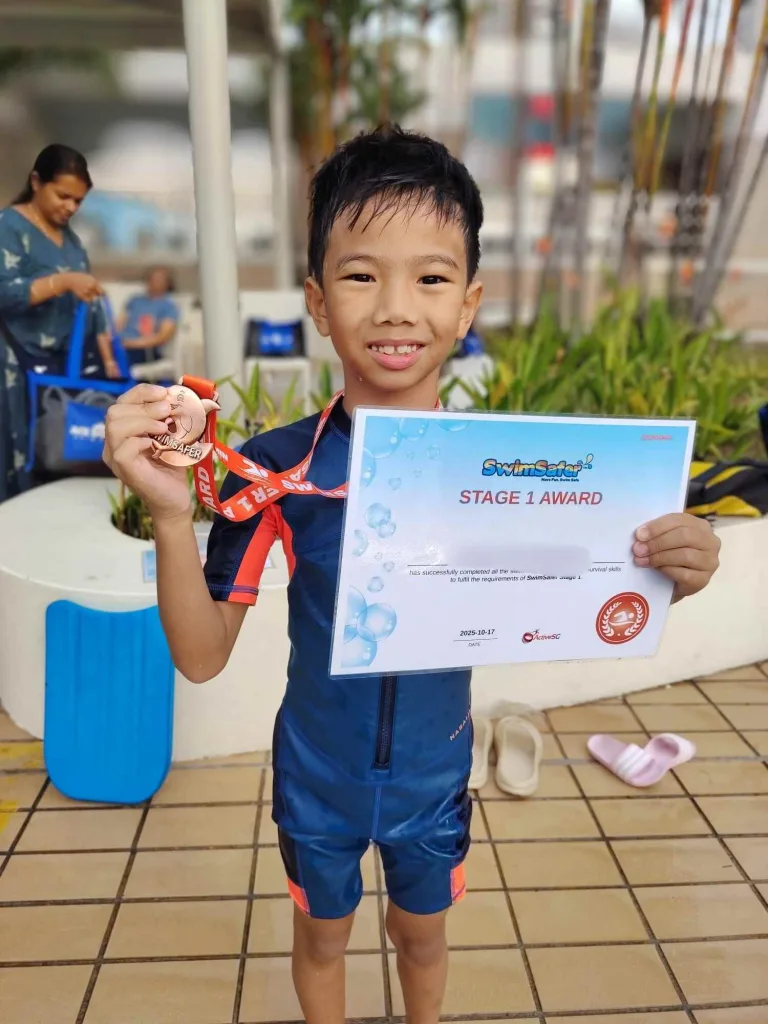
SwimSafer 2.0, Singapore’s national water safety framework under SportSG, is built around six stages: from a first independent float through to Gold-level 400m swims across six strokes. Each stage runs roughly 12 hours of instruction time and ends with a practical assessment plus an online theory quiz before a child receives their e-certificate via FileSG.
That structure matters because it means progression is checkpoint-based, not calendar-based. A child doesn’t graduate a stage because a term ended, they graduate because they demonstrated the specific skills that stage requires, on an actual assessment day, in front of an assessor. This is why two children who started on the same day can be in different stages six months later, and why “my friend’s kid is already in Stage 4” isn’t a useful comparison. Different children build different skills at different rates, and that’s completely normal.
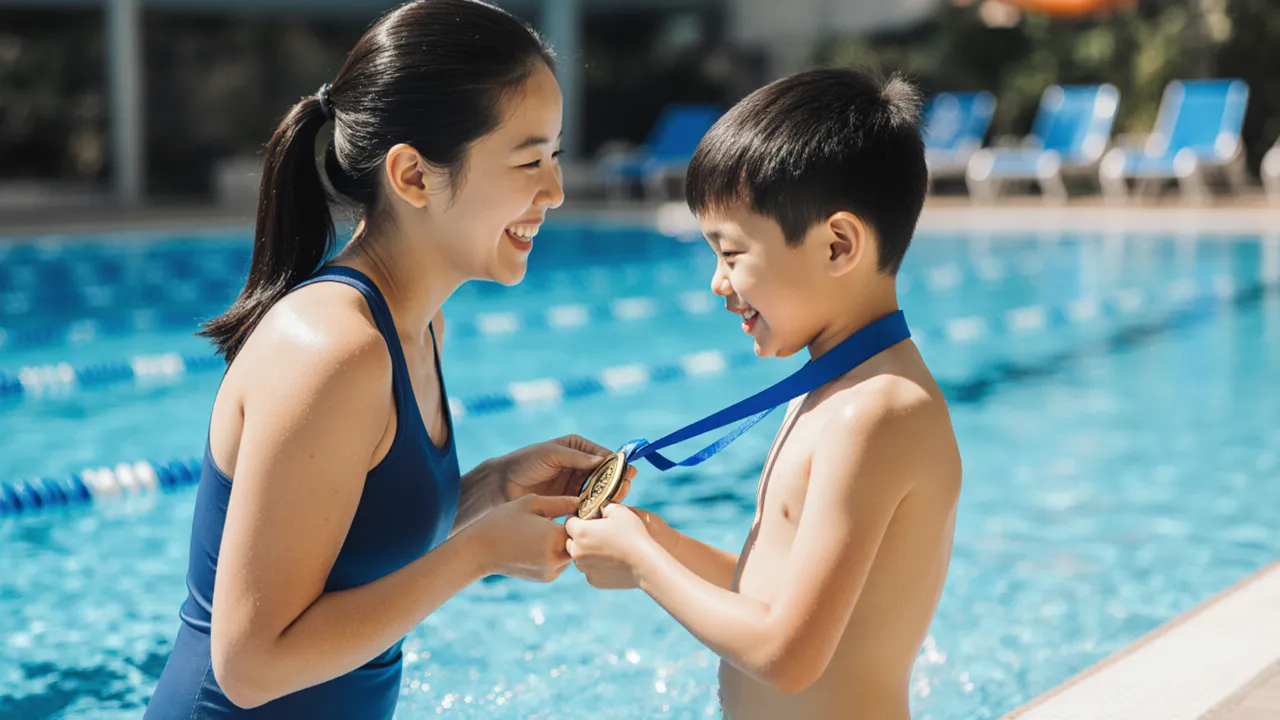
At Ace Dolphin, we track this with a proprietary swim band and custom medal system, every time a child hits a genuine skill milestone, they receive a physical marker of it. Parents tell us this is one of the most reassuring parts of the programme, because progress stops being an abstract “how’s it going?” conversation and becomes something visible: a band on the wrist, a medal in a drawer, a clear signal of what’s actually been mastered.
The Real Readiness Signs (Not Just “They Can Swim a Bit”)
Coaches aren’t looking for a single good lap. They’re looking for consistency across multiple sessions, because a one-off good attempt often reflects a lucky day rather than a mastered skill. Here’s what genuine readiness looks like in practice:
Skill consistency, not skill possibility. If your child can float unassisted once out of five tries, that’s not the same as being able to float reliably. Coaches want to see a skill land correctly on most attempts across at least two or three consecutive lessons before they’ll consider it “banked.”
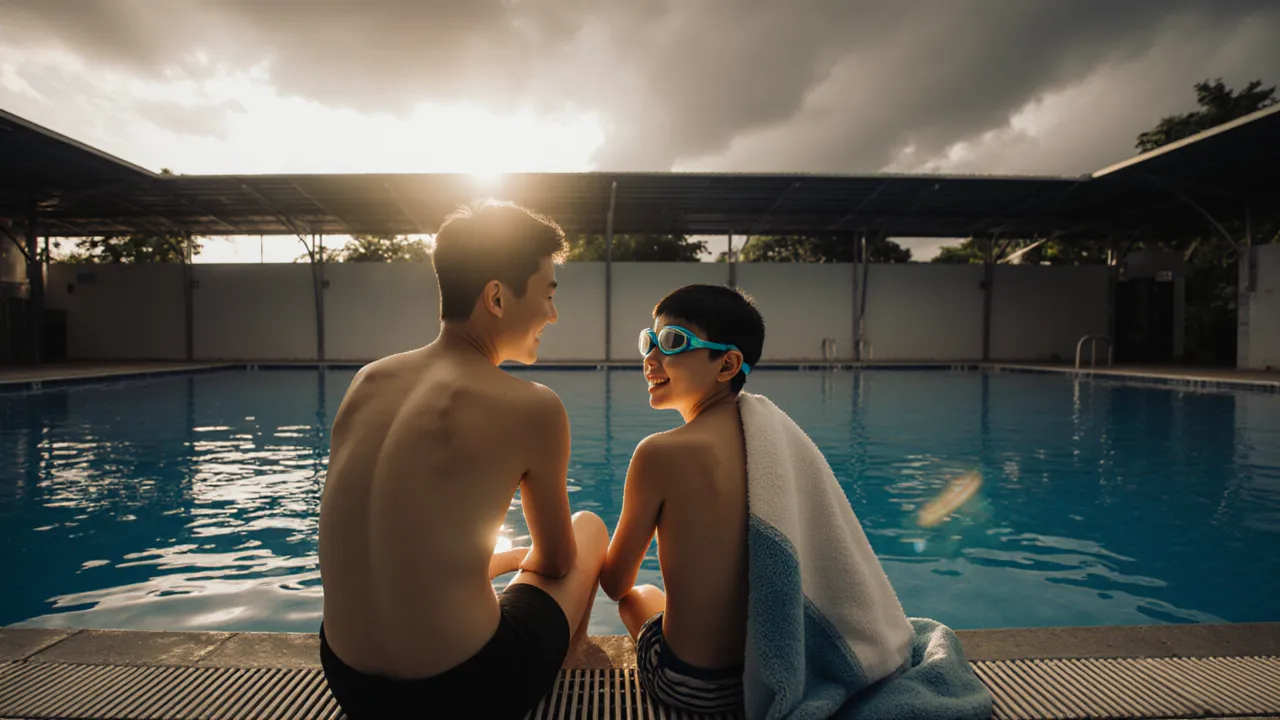
Independence from the wall and from hands. A child who edges toward the wall the moment a coach lets go, or who needs a hand under their back to stay afloat, isn’t yet ready to move on, even if their stroke technique looks fine when supported. Letting go, literally and figuratively, is often the last skill to click, and it’s frequently the one parents underestimate.
Willingness over ability. Some children can technically perform a skill but freeze up when asked to do it away from the coach, in deeper water, or without a kickboard. Readiness includes the emotional piece, a child who attempts a skill without visible anxiety is showing you they’ve actually internalised it, not just memorised the motion.
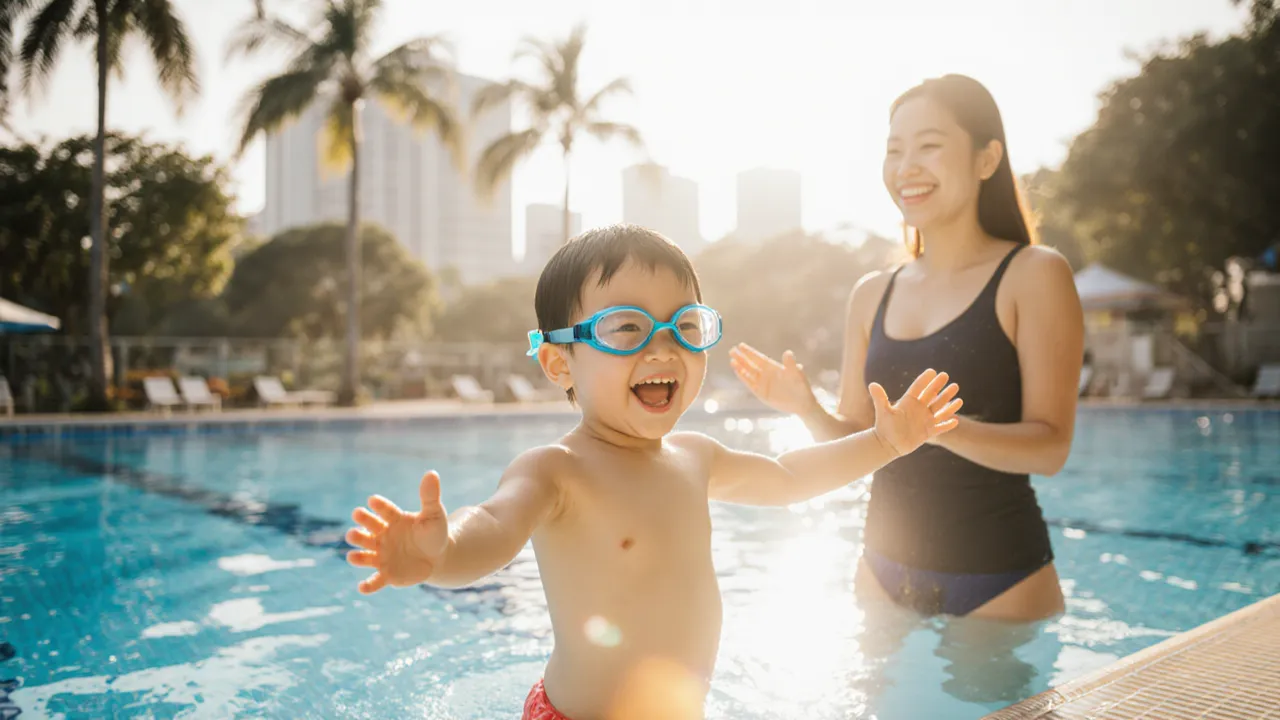
Independent kicking with real propulsion. For the early stages especially, coaches watch for a kick that’s actually moving the child forward, not just splashing. A strong kick is the engine for almost everything that follows, so it’s one of the first things assessed before stage progression is even discussed.
Following multi-step instructions unprompted. As children move into the stroke-development stages (Stage 3 onward), the ability to follow a sequence, “breathe, glide, kick, reach”, without a coach breaking it into single steps each time is a strong signal that a child has the focus and body awareness the next stage demands.
What This Looks Like Stage by Stage
In the foundation stages (1–2), readiness mostly comes down to comfort and independence: entering the water safely without hesitation, floating unaided for a sustained period, and swimming a continuous 25m without stopping to stand. A child who still reaches for the wall reflexively, or who tenses up the moment their face goes under, usually needs more time here regardless of how well they perform the “dry” version of a skill on land.
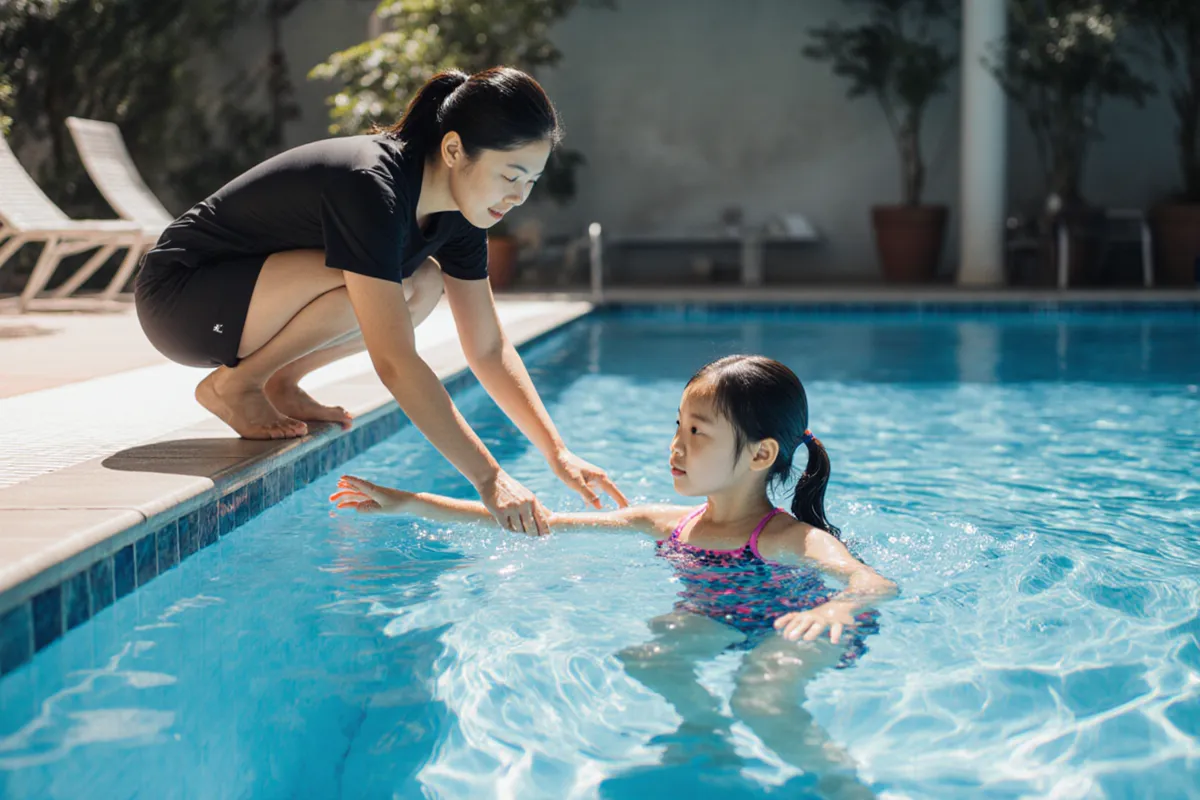
From Stage 3 onward, the bar shifts toward stroke mechanics and self-rescue: stride jump entries, underwater swimming, and, crucially, the coordination to combine breathing with stroke technique rather than doing each in isolation. This is where the Tatsuki Japanese methodology, which Ace Dolphin blends into every stage, becomes especially useful. Japanese swim coaching places heavy emphasis on precision metrics, stroke count, body position, breathing rhythm, rather than just “did they make it across the pool.” That precision tracking gives coaches (and parents) a much clearer, evidence-based answer to “are they ready?” instead of a gut feeling.
By Stage 4 (Bronze) and beyond, readiness increasingly includes endurance and rescue skills, throwing techniques, personal survival in deeper water, and swimming 100m using varied strokes. Children at this level also need to handle feedback well and self-correct without becoming discouraged, which is as much a maturity marker as a physical one.
By Stage 5 (Silver) and Stage 6 (Gold), the readiness picture shifts again toward endurance and independent problem-solving. A child heading into Silver should already be comfortable with basic diving entries and efficient stroke technique over distance, not just able to complete 200m eventually but able to pace themselves through it without panicking halfway. Gold-level readiness is less about any single skill and more about composure under harder conditions, swimming 400m with proper technique, staying calm enough to make a flotation device from clothing, or working through the HELP posture without needing constant reassurance. At this point, coaches are really assessing whether a child can think clearly in the water, not just move through it.
Why Pushing Too Early Almost Always Backfires
It’s tempting to ask a coach to bump your child up, especially if a sibling or classmate is a stage ahead. But children who advance before their foundations are solid tend to hit a wall fast. The next stage assumes the previous one is second nature, and if it isn’t, a child ends up struggling with new skills while also patching gaps in old ones. That combination is exactly what erodes confidence, and confidence is much harder to rebuild than a stroke technique.
This is exactly why Ace Dolphin’s coaches don’t force progression. Our “Calm & Chill” philosophy means a child stays at a stage until the skills are genuinely locked in, not rushed to satisfy a schedule or a parent’s expectation. We’ve seen this matter most with water-anxious children: kids who’ve made “zero progress” for months at other schools often just needed a coach willing to consolidate the basics properly before moving forward, rather than pushing them into deeper water before they were ready. Within weeks of the right pacing, most of these children are swimming independently, float-free. Not because they were rushed, but because they weren’t.
How to Get a Straight Answer From Your Coach
If you’re genuinely unsure where your child stands, ask your coach directly: “What specific skill is my child still working on before the next stage?” A good coach should be able to name it precisely, not “just needs more practice” but something concrete, like “independent floating for 15 seconds” or “combining breathing with freestyle arm stroke.” If you’re not getting a specific answer, that’s worth pushing on.
It’s also worth remembering that assessment days are a snapshot, not a verdict. A child having an off day during a stage test isn’t a reflection of months of progress, most schools, Ace Dolphin included, allow re-assessment once the skill has genuinely stabilised.
One misconception worth clearing up: a child who looks “bored” repeating the same stage isn’t necessarily ready to move on. Boredom often shows up before mastery does, simply because the physical skill takes longer to consolidate than the child’s patience for practising it. A good coach will tell the difference between a child who’s outgrown a stage and one who’s just impatient with it, and will keep the lessons engaging enough that the wait doesn’t feel like a setback either way.
It also helps to separate two different questions parents often merge into one: “is my child capable of the next skill” and “has my child mastered the current one.” A child can often be taught the next stage’s moves in isolation, most kids can be shown how a stride jump entry works, for example, without having actually locked in the fundamentals that make it safe and repeatable under real conditions. Coaches assess the second question, not the first, which is often why a technically “capable” child still isn’t cleared to advance.
The Bottom Line
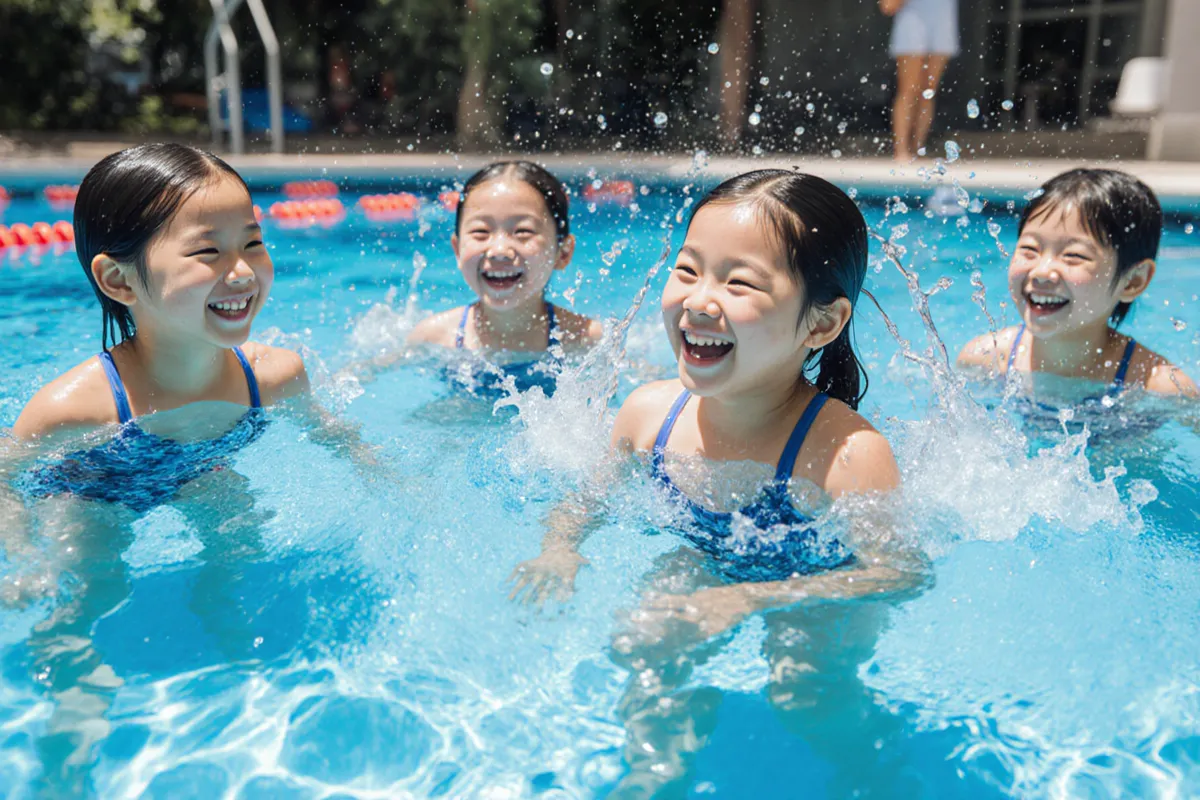
Readiness to move up a SwimSafer level isn’t about age, term length, or what other kids in the class are doing. It’s about consistent, independent, anxiety-free performance of specific skills, and a good coach should be able to tell you exactly which ones your child is still working on.
At Ace Dolphin, our swim band and medal system, combined with the precision-tracking approach from our Tatsuki Japan-certified coaches, means you’ll always know exactly where your child stands and what’s next, no guessing required. If you’d like a clear read on your child’s current stage and what’s holding up (or clearing the way for) their next progression, reach out to us at admin@acedolphin.com or +65 9105 5244, or visit acedolphin.com to find a class at one of our six locations across Tampines, Pasir Ris, Yio Chu Kang, Bishan, Punggol, and Sengkang.
Opening soon at Punggol: our new Punggol pool is opening soon, and pre-registration is now open. Find out more and pre-register on our Punggol page.