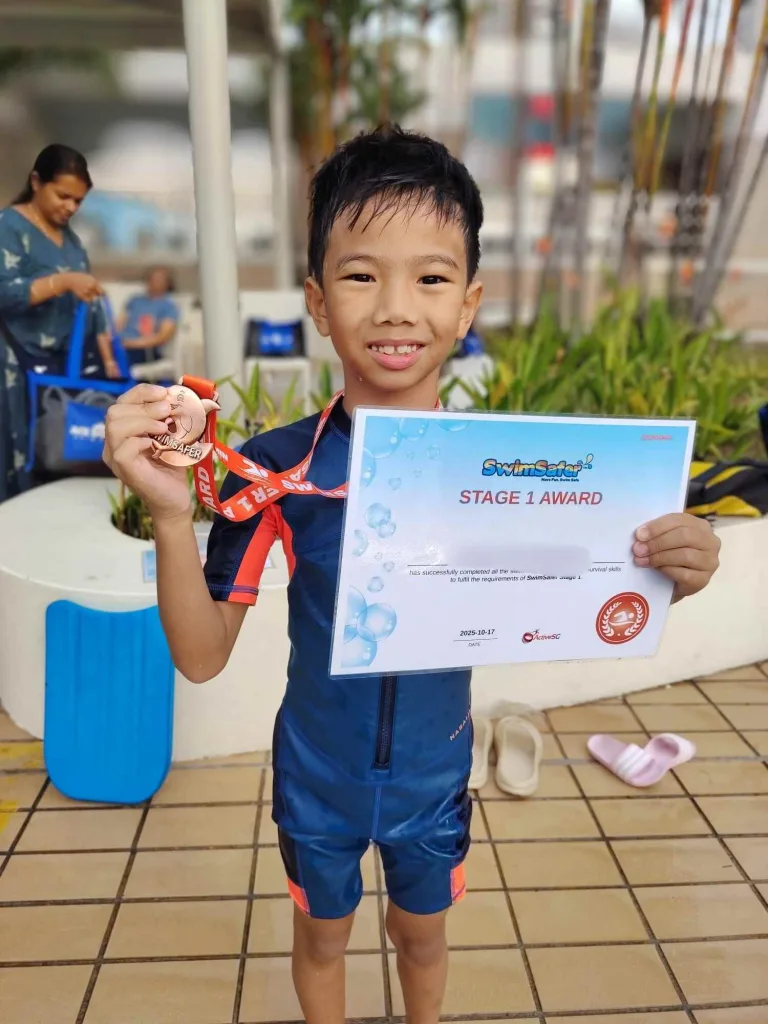
Every school holiday, the same conversation happens poolside across Singapore: one parent mentions their child just cleared SwimSafer Stage 3, and suddenly you’re wondering why yours is “stuck” at Stage 2 after three terms. It’s an easy trap to fall into, because SwimSafer progress doesn’t move in a straight line, and comparing children rarely tells you anything useful about your own child’s readiness.
What actually tells you something is a specific set of skills and behaviours your child either has or doesn’t have yet. This article walks through what each SwimSafer 2.0 stage genuinely demands, the concrete signs, not vague ones, that a child is ready to test up, why so many kids plateau despite regular lessons, and how a structured assessment process takes the guesswork out of the decision entirely.
What Each SwimSafer Stage Actually Requires
SwimSafer 2.0, Singapore’s national water-safety framework, runs across six progressive stages, from basic water familiarisation up to Gold, a stage that includes roughly 400m of continuous swimming across six strokes plus clothed survival skills. Each stage isn’t just “more distance.” The skill demands change qualitatively at every level.
Stages 1–2 focus on breath control, floating unaided, and basic propulsion. Can the child submerge calmly, blow bubbles rhythmically, and glide without panicking when their face is in the water? Stage 3 introduces sustained front and back strokes over short distances, along with treading water. This is where technique starts mattering more than willingness.
Stages 4–5 are where most plateaus happen. Here, a child needs efficient, sustained stroke mechanics, proper breathing rotation, consistent kick timing, and enough stamina to swim continuous laps without stopping to stand. Stage 6 (Gold) demands multi-stroke competency and survival skills under simulated real-world conditions, like swimming in clothes.
Knowing which specific skill your child’s current stage is testing, not just “swimming better” in general, is the first step to judging readiness accurately.
The Real Signs of Readiness (Not Just “Ask the Instructor”)
Parents are often told to “just ask the coach,” which is true but unhelpful if you don’t know what to watch for yourself. Here’s what genuine readiness looks like in the pool, not the changing room.
Effortless repetition. A ready child can perform their current stage’s core skill, say, freestyle breathing to the side, five or six times in a row without the stroke falling apart by the third attempt. If technique holds up only for the first lap and then collapses into panic-paddling, that’s a stamina and consolidation gap, not a testing-day nerves issue.
Recovery without resetting. Watch what happens when your child swallows water or loses rhythm mid-lap. A child ready to progress corrects mid-stroke and keeps going. A child not yet ready stops, stands up, and needs a moment before restarting. a sign the skill isn’t automatic yet.
Comfort in open water sections. Many stage 3–5 tests require swimming without wall support for extended stretches. If your child instinctively drifts toward the pool edge or the lane rope during practice, they’re not yet trusting their own buoyancy and stroke, regardless of how good their form looks near the wall.
They can explain what they’re doing. Ask your child to describe how they breathe during freestyle, or when they kick during backstroke. Kids who can articulate the mechanics, even simply, have internalised the skill rather than just mimicking it. This single conversation often reveals more than watching one lesson.
Why Kids Plateau: It’s Rarely About Effort
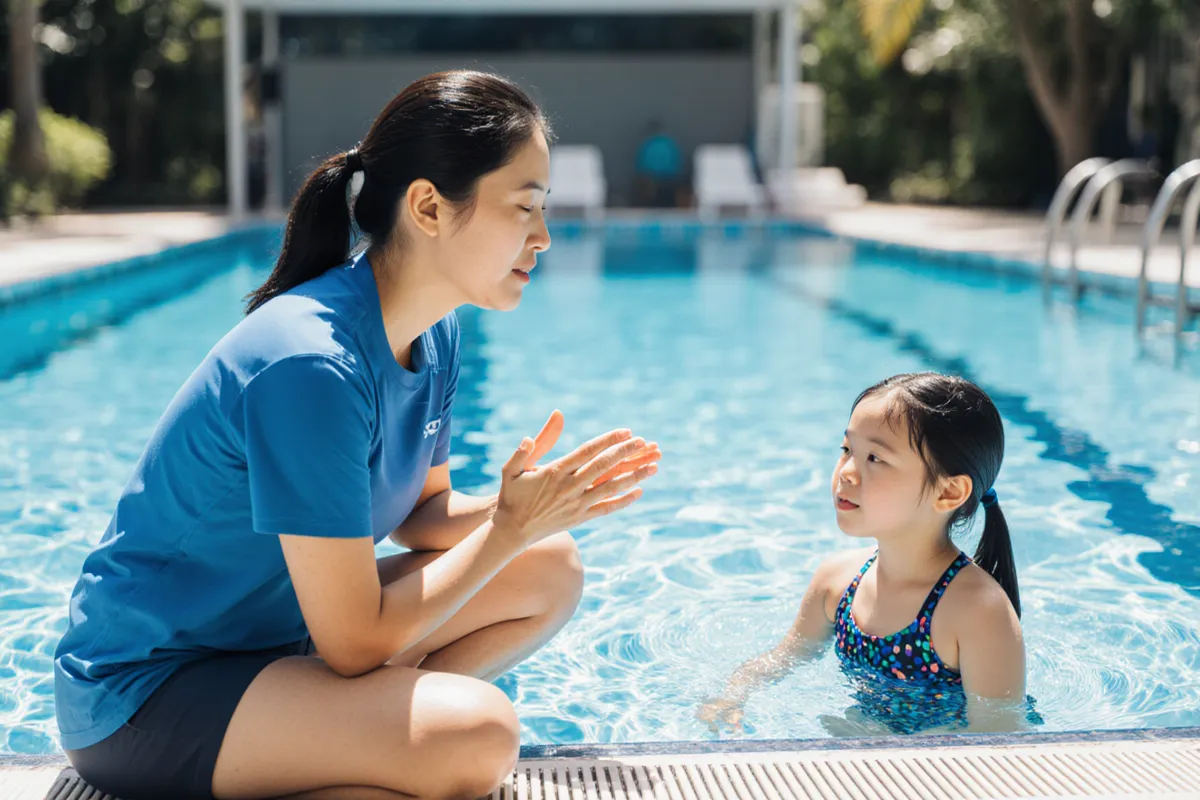
When a child stays at the same stage for several terms, parents often assume it’s a motivation problem. In practice, three other causes are far more common, and they require different fixes.
Attendance gaps. SwimSafer skills are built through consistent muscle memory. A child who attends weekly for six weeks, then misses a month over the June or December school holidays, effectively resets part of that memory. The stroke looks “almost there” every term because the child keeps relearning the same 70%, never quite consolidating the last stretch.
Stroke inefficiency, not lack of ability. A child can often complete a length using pure effort, thrashing, holding breath too long, over-kicking, and still technically finish. But inefficient technique caps out fast. It works at 10m and falls apart at 25m. This is the single biggest reason children plateau specifically at the Stage 4–5 transition, where distance and endurance requirements jump.
Confidence lagging behind actual skill. This is the trickiest one to spot, because it looks identical to a genuine skill gap from the sidelines. A child may have the physical capability to pass a stage but freezes up during open-water sections or unfamiliar drills purely from nerves, not incompetence. Pushing technique drills harder doesn’t fix this. Rebuilding trust in the water does.
This is exactly where precision matters more than general lesson time. At Ace Dolphin, coaches dual-certified under NROC and Japan’s Tatsuki Japan (TJAP) framework track technique markers, stroke count, breathing rhythm, kick consistency, stage by stage, rather than eyeballing general “improvement.” Over a 12-week grading cycle, that data makes it possible to tell a parent precisely whether their child’s plateau is an attendance issue, a technique issue, or a confidence issue, instead of a generic “keep practising.”
How SwimSafer Assessment Actually Works
The formal SwimSafer test, bookable through CAMS (the national booking system used across ActiveSG pools), combines a practical in-water skill demonstration with an online water-safety knowledge quiz that requires roughly 90% to pass. Both halves matter. a child can be strong in the pool and still need to revise water-safety concepts like rip current awareness or clothed-swim principles before the written portion.
Before submitting a child for the official test, most swim schools run internal readiness checks, essentially a dry run of the same criteria the actual assessor will look for. This matters because a failed official attempt can dent a child’s confidence more than a delayed one ever would. A coach who has tracked a child’s technique consistently across the term is far better positioned to judge test-readiness than a one-off observation the week before.
Since SwimSafer is a Ministry of Education requirement tied to school swim programmes, timing tests around school term breaks, rather than squeezing them in during exam periods, also tends to produce calmer, better-prepared attempts.
Private vs Group Coaching: How It Affects Progression Speed
Group classes are excellent for consistency, peer motivation, and cost, and they work well for most children moving through Stages 1–3. But once a child is stuck specifically at a technique bottleneck, say, breathing rotation at Stage 4, group settings can slow progression simply because coach attention is split across the class.
Private or small-group coaching allows a coach to isolate the exact broken element of a stroke and drill it directly, which can compress what might take two terms in a group setting into a matter of weeks. This isn’t about one format being universally “better”. It’s about matching the coaching format to the specific plateau a child is experiencing. A confidence-based plateau often benefits more from a familiar group environment; a pure technique plateau often resolves faster with focused 1-to-1 attention.
When Not to Push a Child Up Before They’re Ready
It’s worth saying plainly: rushing a child into the next SwimSafer stage before they’re genuinely ready usually costs more time than it saves. A child who scrapes through a test on adrenaline, then faces the next stage’s higher distance and stamina demands without a solid foundation, often regresses in confidence even if the certificate says they passed.
Signs a child isn’t ready yet, even if the calendar says it’s “time”: they still need the wall or lane rope for reassurance, their stroke technique degrades noticeably after 15–20m, or they can’t yet explain what they’re doing mid-stroke without stopping to think. None of these are failures, they’re simply information about what to work on next.
Conclusion
The clearest way to know if your child is ready to move up a SwimSafer level isn’t a gut feeling or a comparison to another child at the pool. It’s watching for effortless repetition, mid-stroke recovery, comfort away from the wall, and genuine understanding of the technique. Plateaus are almost always attendance, technique, or confidence issues in disguise, each with a different fix.
This is where having coaches who track progress precisely, rather than generally, makes the difference between guessing and knowing. Ace Dolphin’s NROC and Tatsuki Japan dual-certified coaches follow each child’s technique markers through 12-week grading cycles across all six ActiveSG locations, Tampines, Pasir Ris, Yio Chu Kang, Bishan, Punggol, and Sengkang, so you get a clear, honest answer about where your child stands. If you’d like an assessment of your child’s current SwimSafer readiness, reach out at admin@acedolphin.com, call +65 9105 5244, or visit acedolphin.com.