Your child’s first swimming lesson is booked, the goggles are bought, and then comes the question nobody mentioned during sign-up: where do you actually stand while they swim? Do you pay at the turnstile? Can you sit poolside? And what happens when the sky turns grey halfway through the lesson?
Almost every Singapore swim school runs lessons inside public ActiveSG pools, which means the pool’s rules apply to you as much as to the coaches. This guide covers what ActiveSG pool rules and fees mean for parents of children in swimming lessons, so your first visit feels routine instead of stressful.
Why Most Kids’ Swimming Lessons Happen in ActiveSG Pools
Singapore has a network of public swimming complexes run by Sport Singapore under the ActiveSG banner, and they are where the majority of children learn to swim. The pools are affordable, they are in the heartlands, and they are built to a standard that suits structured coaching, with lanes, shallow ends and lifeguards on duty.
Ace Dolphin teaches at six of them: Our Tampines Hub, Pasir Ris, Yio Chu Kang, Bishan, Punggol and Sengkang. After 15 years of teaching in these pools, one thing is clear: the parents who feel most relaxed are the ones who knew the house rules before day one.
The practical upside of public pools is that your child learns in the same type of environment they will swim in for life, with other people around, real water movement and a proper pool deck. The trade-off is that you share the space, and you follow the complex’s rules.
How Much Does Pool Entry Cost for Parents and Kids?
Check the school’s lesson fee first, because it may or may not include pool entry. Ask this at enquiry stage so there are no surprises. Once you know entry is separate, the numbers are small. According to ActiveSG’s published individual rates, a standard swimming complex charges adults $1.00 on weekdays and $1.30 on weekends and public holidays, while children pay $0.50 on weekdays and $0.60 on weekends and public holidays. Complexes with special features, such as wave or slide areas, charge more, at $1.50 to $2.00 for adults and $0.80 to $1.00 for children.
Those are the discounted rates for ActiveSG members. Non-members pay the higher standard rate, so a free ActiveSG account is worth setting up before the first lesson.
Is the monthly swim pass worth it?
If your child swims once a week, per-entry fees are cheap enough that a pass barely matters. It starts to make sense if you also take the family for free swims. ActiveSG’s MyActiveSWIM membership offers unlimited access to ActiveSG swimming complexes islandwide at $10 a month for adults and $5 a month for children aged 1 to 17. A family of four swimming together twice a week would likely come out ahead; a parent who only watches from the stands would not.
One caveat: ActiveSG revises rates and passes periodically, so confirm current pricing on the ActiveSG website before you commit to anything.
The Rules That Catch Parents Out
ActiveSG’s general admission rules are short, but a few of them trip up first-time swim parents again and again.
Swimwear: shorts and diapers are not allowed
The rules ask for appropriate swimwear and specifically prohibit street wear, translucent materials, shorts without an inner lining, undergarments and diapers. For children that means proper swim trunks or a one-piece, and no cotton T-shirts over the top. If your child is still in nappies, a standard disposable is not acceptable in the water, so speak to your school about alternatives or consider our free partner matching for the very young.
Children aged 6 and under need an adult within arm’s reach
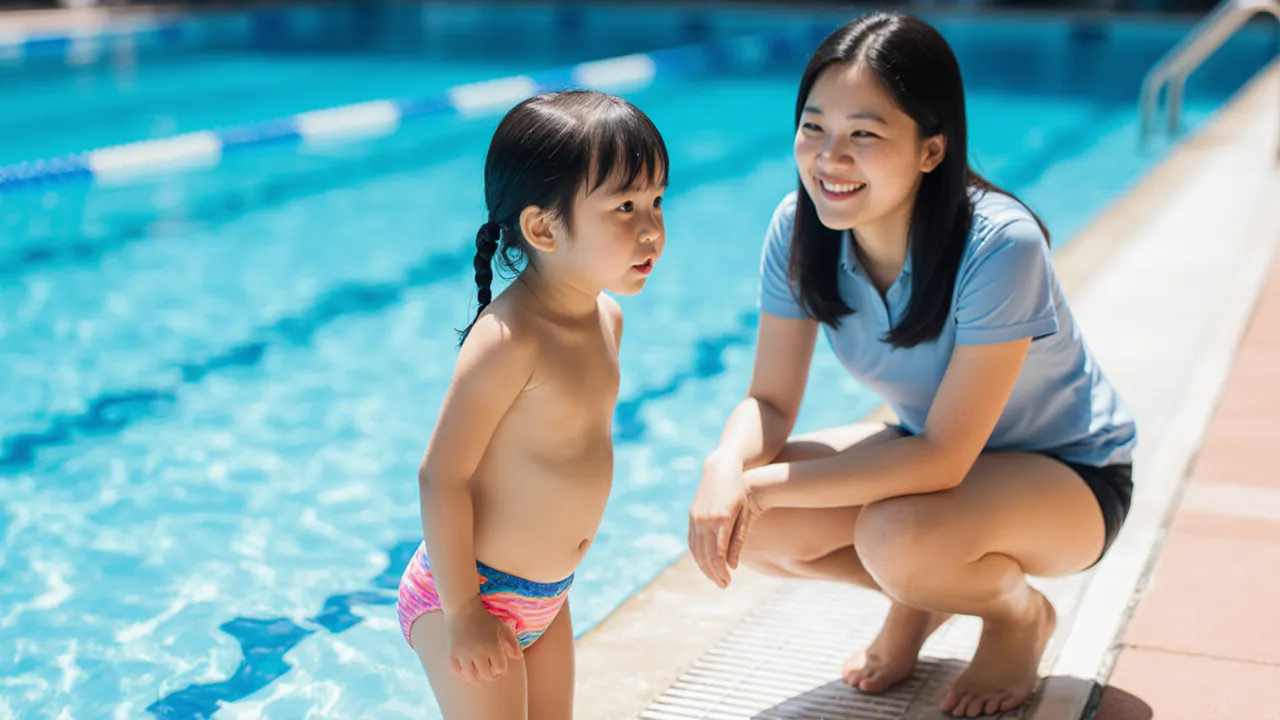
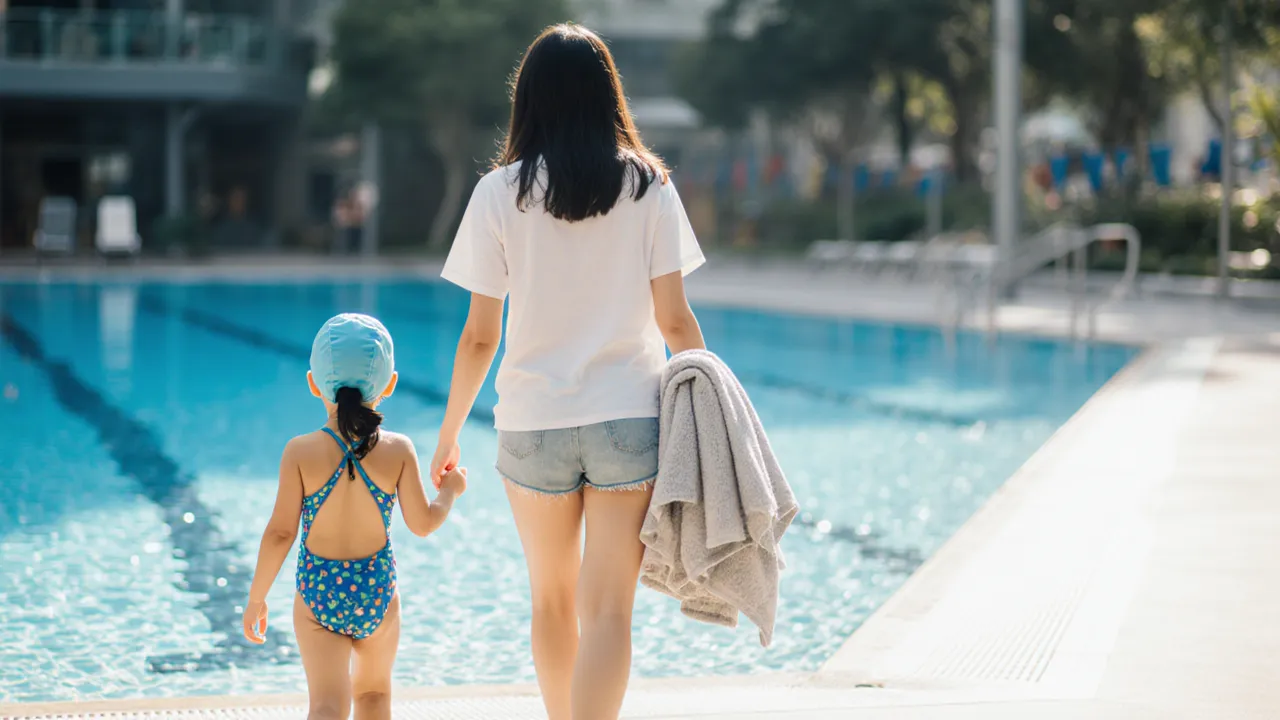
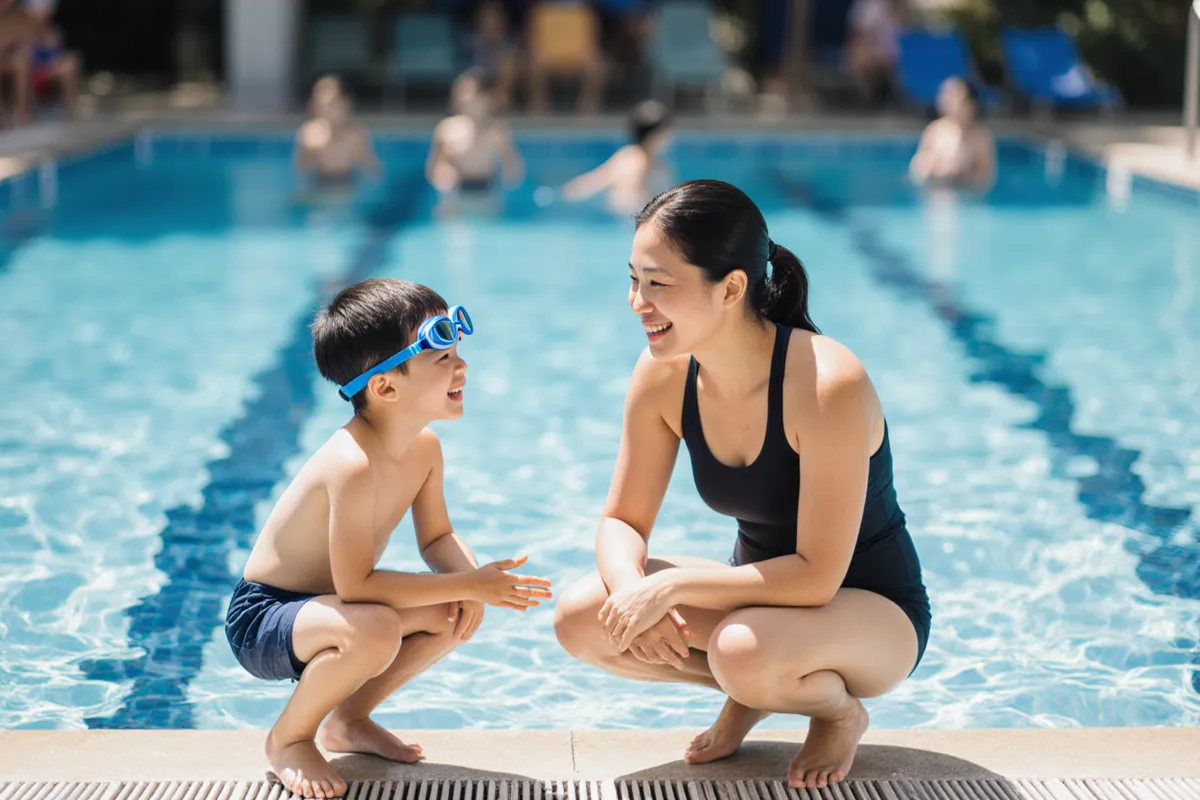
This one surprises people. ActiveSG states that children aged 6 years and under must be accompanied by, and kept within arm’s reach of, an adult who is responsible for the child’s safety. During a coached lesson, the coach has the child in the water. But on the pool deck before and after the lesson, a young child should never be left to wander while you queue for the changing room or look for the towel.
Treat the walk from changing room to pool edge as part of the supervised window. Wet tiles and excited four-year-olds are a bad combination.
Shower first, and leave the snacks outside
A rinse before entering the pool is required, and food and drink are not allowed within the facility. Pack the snack for the bench outside the complex or the car ride home, and bring a water bottle you can keep sealed in your bag.
What Happens When It Thunders?
Singapore weather does not read the lesson schedule. ActiveSG rules state that in the event of lightning, thunder or other hazardous natural conditions, all users must leave the pool and any open area on staff instruction. That is a safety call made by the pool staff, not the coach, and it is not negotiable.
For parents, the useful thing is to plan for it. Afternoon thunderstorms are common in the wetter months, so a child with a late-afternoon slot is more likely to lose pool time than one with an early morning lesson. Keep a dry towel and a change of clothes in the bag, and a light jacket for a child who gets cold quickly once they leave the water.
Ask your school how it handles weather interruptions before you enrol. Ace Dolphin’s long-term programmes include unlimited make-up lessons, and you can request a make-up lesson online, so a stormy Saturday does not mean a lost session.
Where Should Parents Sit and Watch?
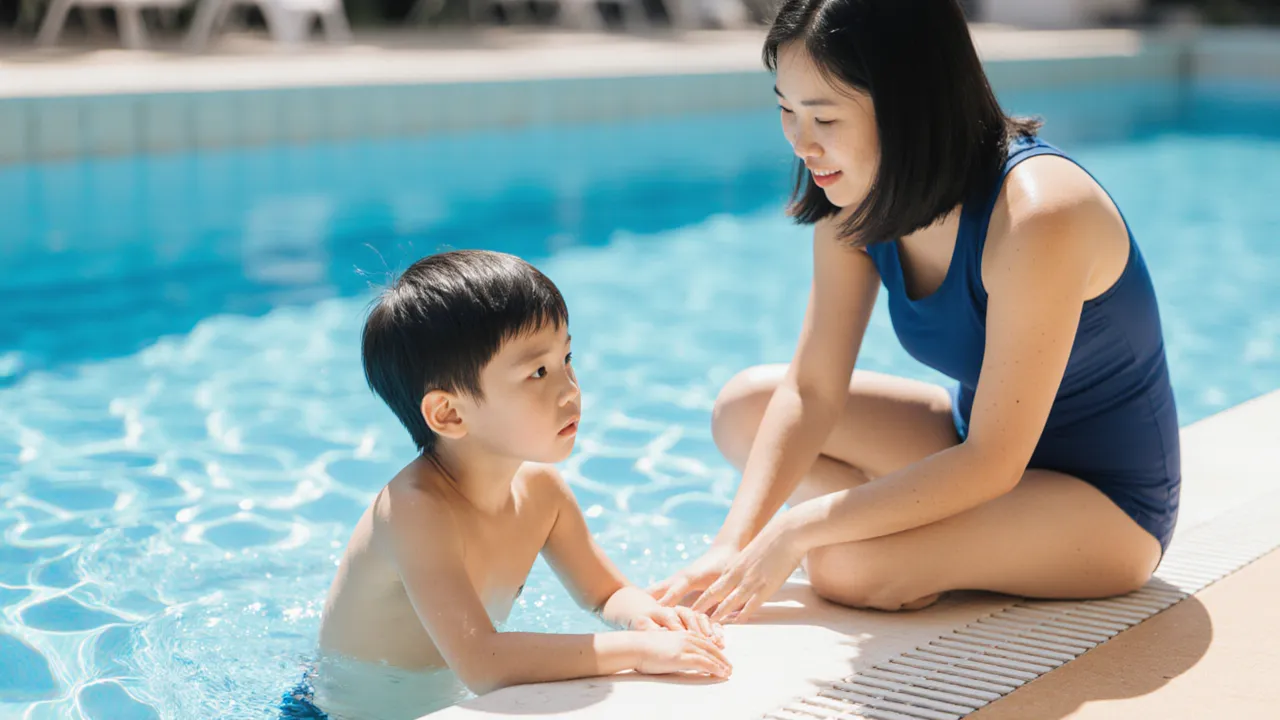
Most ActiveSG complexes have spectator seating or a shaded area near the pool. Whether you may stand at the pool edge depends on the complex and the lesson, and coaches usually prefer parents to stay back so the children focus on them rather than on you.
There is a real teaching reason for this. A child who can see a parent will often look for them, call out, or cling to the edge to be rescued the moment they feel unsure. This matters most for children who are nervous in water. Coaches who specialise in anxious swimmers, like the ones at Ace Dolphin, work on building trust one small step at a time, and a parent hovering at the edge can reset that progress.
If your child is struggling to separate from you, tell the coach in advance. A short wave from the stands and a calm smile does more than rushing over, and it teaches your child that being brave in the water is something they can do on their own. If tears are a regular feature of lesson days, our guide on what to do when your child cries at swimming lessons is worth a read.
A Simple Pool-Day Checklist for Parents
Once you know the rules, the routine is easy. Here is what experienced swim parents pack and plan for, based on what we see week after week across our six venues.
- Swimwear worn under clothes that meets pool rules, plus a spare set in the bag.
- Goggles and a swim cap that your child has already tried on at home, so the first lesson is not also the first time they wear them.
- A hooded towel and a change of clothes for the post-lesson walk, especially for children who chill quickly under air-conditioning.
- Your ActiveSG account or membership details, ready at the gantry so you are not holding up the queue.
- A small snack and water bottle for after the lesson, kept outside the pool area.
- Arrival 10 to 15 minutes early to shower, find the meeting point and let your child settle.
Our guide to preparing your child for their first swimming lesson goes deeper on the emotional side, and the first lesson location guide shows you exactly where to meet your coach at each venue.
Why Venue Knowledge Matters More Than It Seems
It sounds trivial, but a calm, prepared arrival changes how a lesson goes. Children pick up on a parent’s stress within seconds. If you are hunting for the entrance, arguing with a turnstile or worrying about whether you are allowed to be at the pool edge, your child feels it and starts the lesson already on edge.
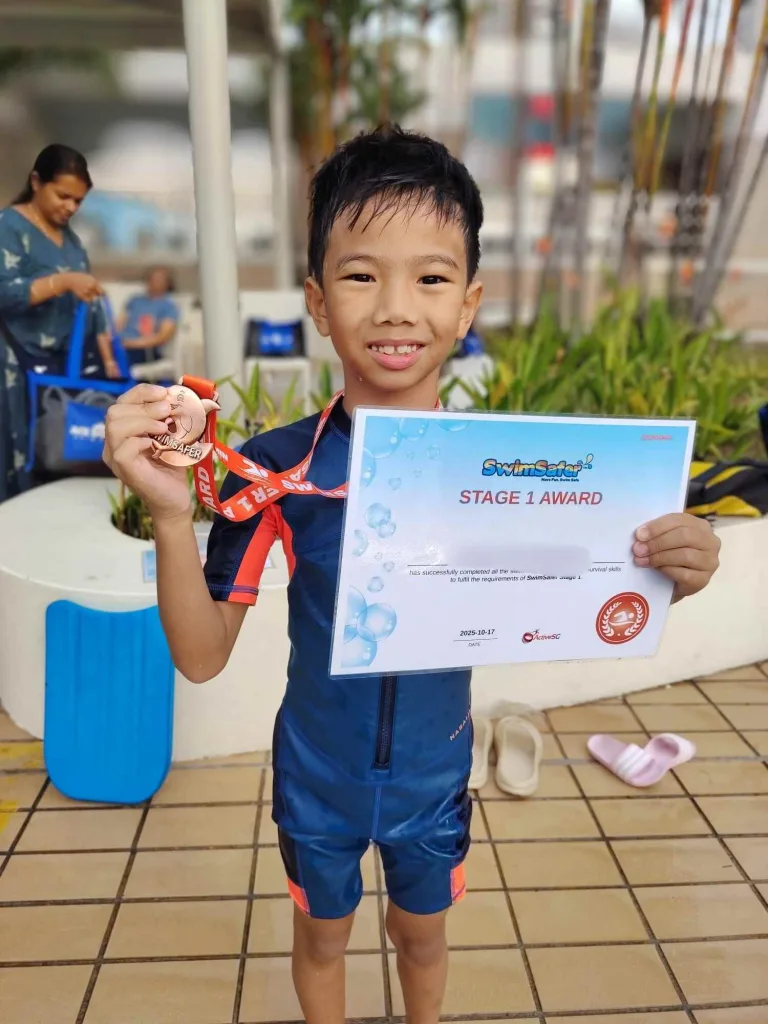
The families who see the fastest progress are rarely the ones with the most athletic children. They are the ones who show up on time, keep the routine consistent and let the coach do the coaching. At Ace Dolphin, where lessons follow SwimSafer 2.0 alongside the Japanese Tatsuki methodology in 12-week grading cycles, that consistency is what makes each stage feel achievable instead of overwhelming.
Questions Parents Ask Before Their First Visit
Do I need to pay entry if I am only watching?
It depends on the complex and how your pass is set up, so ask the pool counter or your school at enquiry. Many parents are surprised to find that spectators sometimes need entry too, and this is also where a family membership can pay for itself.
Can I bring my toddler along to watch their older sibling?
Yes, but remember the arm’s-reach rule for under-sevens and the swimwear and diaper rules if they go near the water. Bring a second adult on lesson days if you can.
What if my child is scared of the pool deck, not just the water?
That is common. Echoing noise, strange smells and big open water can all feel overwhelming to a young child. Let them visit the pool once before the first lesson, just to look and get comfortable. Our coaches are used to working with children who need a slow start, and nobody is forced into the water before they are ready.
Conclusion
Public pool logistics are a small part of learning to swim, but they decide whether lesson day feels smooth or chaotic. Know the entry fees, respect the swimwear and supervision rules, plan for Singapore’s sudden thunderstorms, and let the coach take the lead once your child is in the water.
If you would like a school that handles the water side with patience while you handle the logistics with confidence, Ace Dolphin teaches at six ActiveSG pools across the island. Read what other families say on our testimonials page, or contact us at admin@acedolphin.com or +65 9105 5244 to find the nearest venue and class timing for your child.